This document contains Confidential, Proprietary, and Copyright Information of Braven, which may not be shared, reproduced, or otherwise distributed or used in any form without the express written consent of Braven.
Each year, nearly 1.4 million students from low-income or first-generation backgrounds enter college, believing they’re on the path to the American Dream (1). But for too many, that promise is broken when it should matter most: the transition from college to career.
On average, low-income Bachelor’s degree holders start their careers earning just 86 cents for every dollar earned by their higher-income peers (about $10,000 less a year)(2). This gap widens over time, resulting in fewer career opportunities and about half as much in lifetime earnings(3). At the root of this is a growing mismatch between what college was designed to deliver and what today’s economy demands. Employers expect not just a degree, but skills, experience, networks and confidence–assets that students from low-income and first-generation families often struggle to access while juggling work and school, without the professional guidance or networks of higher-income peers.
We believe now is the moment to move beyond today’s status quo and pursue a new approach. With mounting pressure from students, policymakers, and employers to ensure that college leads to strong careers, especially given the challenges in the labor market and the rapid changes brought on by AI, higher education institutions are rethinking how they prepare students for the future workforce. But colleges need support. While many universities have made notable strides, most still lack the level of funding, staffing, and depth of employer partnerships needed to deliver career-connected learning at scale.
Our mission is to close the college-to-career gap for low-income and/or first-generation college students–and prove that economic mobility is possible at scale–by transforming how higher education and employers prepare students for the workforce.
Braven provides an evidence-based model that demonstrates to institutions and policymakers that this transformation is possible. Braven partners deeply with higher education institutions and employers to embed career preparation into the undergraduate experience–reaching all students, not just the confident or connected. Braven offers a three-year experience that begins with a credit-bearing course, built into the curriculum and paired with continued program support through graduation and entry into the workforce. Fellows graduate better equipped to navigate a rapidly changing job market and secure strong first jobs, setting them up for long-term success. At the same time, Braven gives employers access to job-ready talent and valuable volunteer opportunities that develop their own employees as more skilled managers and leaders.
This model is already delivering powerful results at a meaningful scale. In our first chapter (FY14-FY25)(4), we’ve supported 14,000 Fellows across nine campuses, and partnered with 15,500 volunteers and 75 employers, all while remaining laser-focused on our North Star. Fellows are 42% more likely than graduates from peer institutions with similar demographics to secure a strong, full-time first job– one with a competitive salary, benefits, and promotion pathways–or to enroll in graduate school within six months (5). They earn, on average, $9,100 more annually than recent graduates nationally, putting them within reach of closing the $10,000 earning gap that typically separates low-income and high-income graduates (6). By proving what’s possible, Braven is poised to help catalyze a broader shift–one where strong career outcomes become the expectation across higher education, not the exception.
Over the next five years (FY26-FY30), Braven will directly support 50,000 students in securing strong first jobs, unlocking at least $8B in additional lifetime earnings. At the same time, we will also influence the policies and practices that shape career preparation for hundreds of thousands more. These outcomes will transform not only students’ lives, but also those of their families and the economic growth of their communities.
This second chapter of our journey will make Braven the largest college-to-career preparation partner in the US–in deep collaboration with higher ed and employers. By integrating our model in ~25 institutions across the country, we will demonstrate for policymakers and higher education leaders that career-connected education can be effective, scalable, and central to the college experience. This progress will set the stage for a third chapter (FY31-FY40): one where strong career outcomes become the norm in higher education for all students, powered by an ecosystem of public funding, data, and strong collaboration across higher education and employers. It’s how we close the college-to-career gap for good—and deliver on the promise of the American Dream.
Jamila transferred to Rutgers University-Newark from community college on a STEM scholarship, determined to build a better future for herself and her family. A first-generation college student and working mom, she grew up with hardworking parents — her mother a hairdresser, her father a carpenter. But as she applied for internships, she noticed a ceiling: the students who were landing offers had parents with personal connections and insider advice, while she struggled to navigate professional spaces alone. She started to doubt she could ever secure a strong job.
Each year, students from low-income or first-generation backgrounds move into dorm rooms and walk into college lecture halls, thinking — rightly — that a bachelor’s degree is the surest path to the American Dream (7). However, even when these students do everything asked of them — enrolling, persisting, and graduating — they don’t receive sufficient support at the exact point that should be their launchpad: the transition from college to career.
A shocking 70% of first-generation and low-income college students do not land a strong job after graduation (8). On average, a low-income bachelor’s degree-holder starts their career earning just 86 cents for every dollar their higher-income peers make (9), a gap that widens over time (10). These differences add up: a low-income bachelor’s degree holder earns approximately half the lifetime earnings of their peers from higher-income backgrounds (11).
The gap between college and career has widened dramatically as the labor market has grown more complex (12). For much of the last century, a college degree was a reliable signal of job readiness. But in today’s economy, employers increasingly expect graduates to also arrive with four key assets: professional skills, confidence to navigate professional spaces, real-world experience, and strong networks. Yet, these are precisely the assets that low-income and first-generation college students are least likely to have (13). Skills like communication and problem-solving are often assumed, but not explicitly taught (14), and confidence is frequently undermined by unwarranted self-doubt — even among top performers (15). Many students from low-income backgrounds must work while in school, so miss out on internships and experiential learning (16), and they are three times less likely to have access to professional networks (17). It’s no surprise, then, that business leaders find recent graduates missing key skills, with just 37% rating them as proficient in leadership, for example (18). The result is a broken talent pipeline: students fall short of their potential, and employers struggle to find the talent they need.
But this gap is not inevitable: when students gain these assets, outcomes quickly shift. A Harvard report found that programs teaching professional skills consistently improve career confidence, especially for students with limited access to the professional workforce, and that paid internships increase earnings after college (19). Other research by Raj Chetty and others shows that cross-class networks — including mentorship — are among the strongest predictors of upward income mobility (20). These are not innate advantages; they are coachable and buildable skills if students are given the chance to learn them.
Public pressure on higher education has increased dramatically. Only 1 in 4 adults in the US believe a four-year degree is essential for getting a well-paying job, and half say it’s less important than it was 20 years ago (21). This growing skepticism reflects deeper cracks in the American Dream, especially for low-income and first-generation students. Meanwhile, AI is accelerating the shift in what employers expect: not just credentials, but adaptable, AI proficient, work-ready talent with human skills and relationships that remain irreplaceable. In response to this shifting environment, 20 states have moved to tie two- and four-year college funding directly to employment outcomes, signaling a new and urgent standard: not just graduation, but true economic mobility (22).
Higher education institutions want to close this gap, but most — especially those with limited financial resources — can’t do it alone. Most colleges were designed to deliver academic learning, not to guide students into the workforce. Even the most well-resourced institutions have had to invest heavily to adapt, offering intensive advising, exclusive internships (23), powerful alumni networks, and one career staffer for every 150 students — backed by endowments of hundreds of thousands per student. In contrast, the financially constrained colleges and universities that serve most low-income and first-generation students are expected to achieve similar outcomes, often with less than $15,000 per student and a handful of career staff for an entire campus (24). Many have stretched these limited resources to create opportunities for students, but with the right support, they could become even more powerful drivers of economic mobility.
As colleges face increasing pressure to demonstrate return on investment, the moment presents a key opportunity to prioritize high-quality, evidence-based solutions. We have the chance to create real, lasting change.
To meet the moment, the field needs a credible, scalable model and a trusted voice to help define what comes next. We offer both. With a proven track record, strong partnerships, and growing momentum, Braven is ready to scale its impact and bring its voice–as well as that of its partners–to the forefront of the national conversation about how college leads to career. We can build a durable bridge from college to career, ensuring students don’t just graduate, but launch toward success.
Jamila’s scholarship program required her to participate in the Braven experience. In it, she learned how to confidently tell her story and build a network that previously felt out of reach. A Braven Employer Partner not only interviewed her for an internship but helped her prepare for it — a chance that led to a full-time job and two promotions within three years. Today, Jamila gives back as a Braven volunteer and strengthens her company’s relationship with the organization.
Our mission is to close the college-to-career gap for low-income and first-generation college students and show that economic mobility is possible when career preparation is built into the college experience. By 2030, Braven will help 50,000 more students secure strong first jobs, while shaping the field to prioritize career outcomes for hundreds of thousands more nationwide.
This scale will lay the groundwork for widespread change: deeper and broader partnerships with the institutions and employers best positioned to reach students, tools, and infrastructure that enable more efficient delivery of quality career preparation, and policy and funding conditions that could embed this work more broadly and sustainably. Together, these efforts will drive stronger outcomes and begin to shift the norms, incentives, and expectations that shape how career preparation is delivered, ensuring it is effective and accessible for all.
Braven serves as a bridge between college and career — delivered alongside universities and employers — to propel students into strong first jobs.
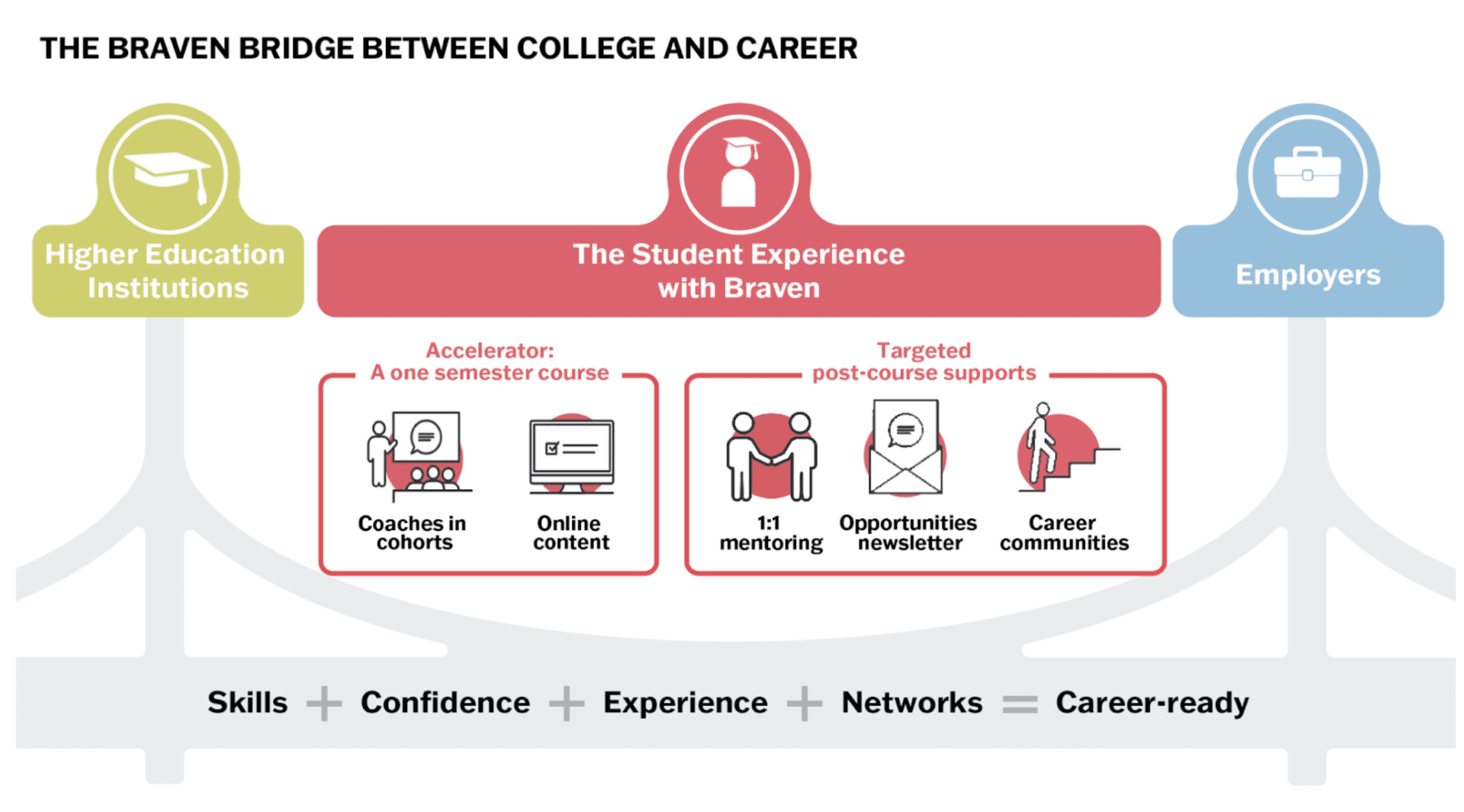
The Braven student experience is designed to build the skills, networks, confidence, and experience needed to succeed. It begins with the one-semester, credit-bearing Accelerator course, typically taken sophomore or junior year. The curriculum builds timeless skills: leadership, communication, problem-solving, organization, teamwork, technology, and career navigation. Unlike most career programs that train students for specific fields or market trends that become outdated, these skills hold value across roles, sectors, and time.
The Accelerator is rigorous, interactive, and tailored for students balancing the demands of school, work, and family. Each week, Braven students — called Fellows — spend about two hours on readings and online modules, then join a two-hour class in cohorts of 5 to 8 students led by workforce volunteers, known as Leadership Coaches. There, Fellows apply what they’re learning — developing LinkedIn profiles and resumes and practicing mock interviews and elevator pitches. The course culminates in the Capstone Challenge, in which Fellows collaborate on a project to solve a real-world business problem.
After completing the Accelerator, Fellows stay connected with targeted post-course supports, including mentors, career-building experiences, and curated Career Communities in fields like STEM, business, healthcare, and education. These supports are enabled through MyBraven, a digital platform that provides personalized tools, job opportunities, and structured guidance through graduation and into their strong first job.
Throughout the experience, students build the professional networks that are critical to economic mobility. Through sustained engagement with Leadership Coaches, mentors, and other employer volunteers, Fellows gain access to the social capital across class lines and real-world exposure that are often unavailable to low-income and first-generation students. In other words: Braven has figured out how to manufacture social capital. It’s this people-powered approach that fuels stronger job matches, sustained wage gains, and long-term career confidence.

We work shoulder-to-shoulder with higher education leaders and employers, offering a high-impact, turnkey solution that complements both under-resourced college career centers and corporate leadership development initiatives.
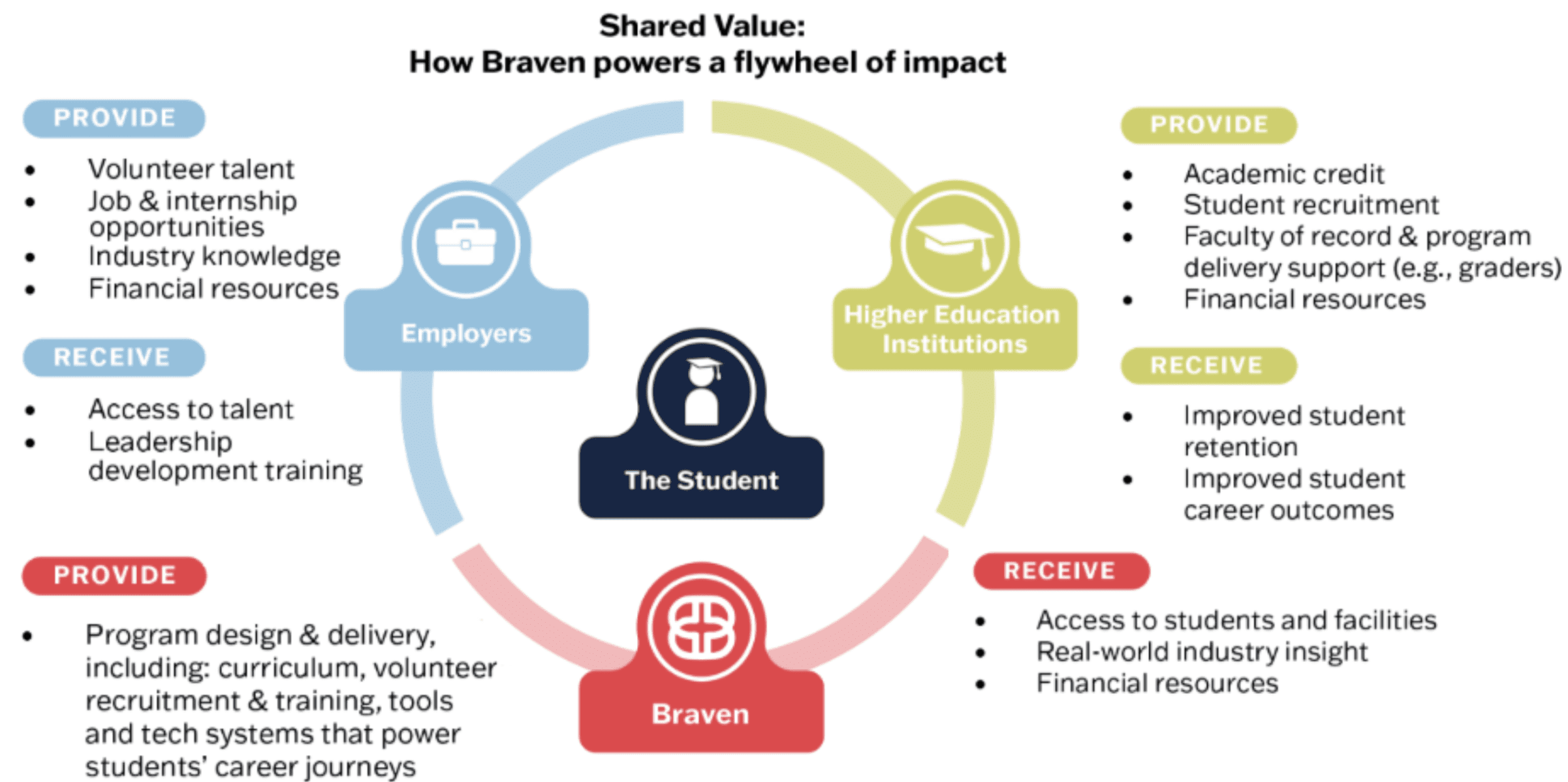
Higher Education Institutions: Braven collaborates closely with institutional leaders to integrate the Braven experience onto campus, beginning with the credit-bearing Accelerator course led by Braven staff and volunteer Leadership Coaches, in partnership with a campus-based Professor of Record and teaching assistants. Institutions invest $500-$1,000 per student based on their resources to support delivery — up to 30% of delivery costs at scale. This is a significant commitment for these schools that reflects shared ownership. In return, schools gain expanded capacity, improved student outcomes, and greater ability to meet rising expectations from students, families, employers, and legislators.
To maximize student impact and institutional value, Braven works to embed the Accelerator across the majority of the sophomore and transfer junior cohorts, often as a required or opt-out course. Through this embedded model, Braven serves the full range of students, including transfer students, academic middle-performers, and students juggling work, caregiving, or doubts about whether they belong in college at all. This structure limits the potential for cherry-picking high performers and aligns with what higher education leaders want: a scalable solution that offers excellent career preparation for all students.
Braven’s target higher education market
Braven focuses on financially constrained schools with high-need student populations (≥30% Pell-eligible or first-generation), graduation rates above 30%, and enough sophomores to sustain the program (25). Of 2,700 four-year institutions, nearly 650 meet these criteria — serving 75% of all low-income and first-generation US college students.
Employer Partners: Employer partners provide both financial investment and volunteer talent, helping fuel a model where half our programmatic revenue comes from the private sector. This reflects a growing recognition that traditional hiring pipelines fall short and that companies must play a more active role in cultivating the talent they need. US employers spend an estimated $4 billion annually retraining recent graduates in basic competencies, and up to $10,000 per entry-level hire (27). These are costs Braven helps to reduce by delivering job-ready talent (28). Employees serve as Leadership Coaches, mentors, and mock interviewers, supported by Braven’s training and guidance — gaining valuable professional experience in leadership and team development in the process. These experiences also build a deeper commitment to hiring and advancing students from first-generation and low-income backgrounds. These engagements deliver value for students and companies alike: increasing access to high-potential talent, strengthening employee development, and shaping a more prepared workforce.
HOW THE WORK UNFOLDS
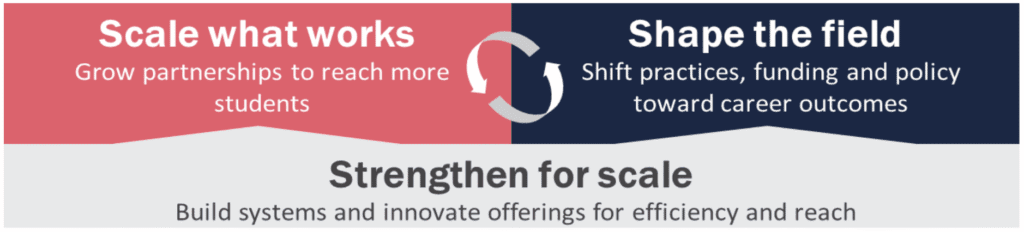
To close the college-to-career gap at scale, Braven’s next chapter will both scale its direct-service model and shape the field to make high-quality, career-connected education the norm. These strategies reinforce each other: as Braven’s reach grows, its outcomes generate the data and momentum needed to influence the field; as policy and funding shift, demand for Braven’s model accelerates. To power this flywheel, Braven will invest in technology, talent, and program innovations that make its model more scalable and effective.
Ensuring the ongoing strength of the model: During our five-year strategic plan, we’ll deepen our evidence base through investing in a set of rigorous external research partnerships to build a robust evidence base around our North Star outcome: securing strong first jobs for our Fellows. In partnership with AIR, we are launching impact evaluations at Rutgers University-Newark and Spelman College — spanning different institutional contexts and both new and long-standing partners — to demonstrate Braven’s effect on job and graduate school attainment. We are also partnering with Opportunity Insights to examine longer-term employment and earnings outcomes two and five years post-graduation, giving us an unprecedented look at Braven’s lasting impact on economic mobility.
Alongside this external research, we are strengthening our already robust internal learning and measurement systems to drive faster continuous improvement at scale. This means upgrading our data infrastructure to make outcomes data more accessible and actionable in real time, refining our metrics to better capture both leading indicators and long-term outcomes, and developing more sophisticated needs profiles for Fellows so we can deliver targeted interventions based on individual career-readiness needs. To ensure our model reflects our communities’ needs and is always anchored in impact, we engage students, employers, and academic leaders through surveys, focus groups, and advisory bodies like our Faculty Council of leaders from partner institutions. We also track quality opportunity attainment and leading indicators like skill and confidence gains, graduation rates, and internship rates to drive improvement. Additionally, we’re enhancing MyBraven (Braven’s digital hub for students) for more personalized student support. Together, these investments will sharpen our ability to improve student outcomes as we grow.
Reaching more students: We will grow from 3,400 new Fellows per year across nine institutions in 2025 to 15,000 across 24 institutions by 2030 — scaling the Braven experience nearly fivefold. Building on what works — regional concentration, school system partnerships, and integration with employer talent development — we will reach more students, more efficiently without compromising outcomes.
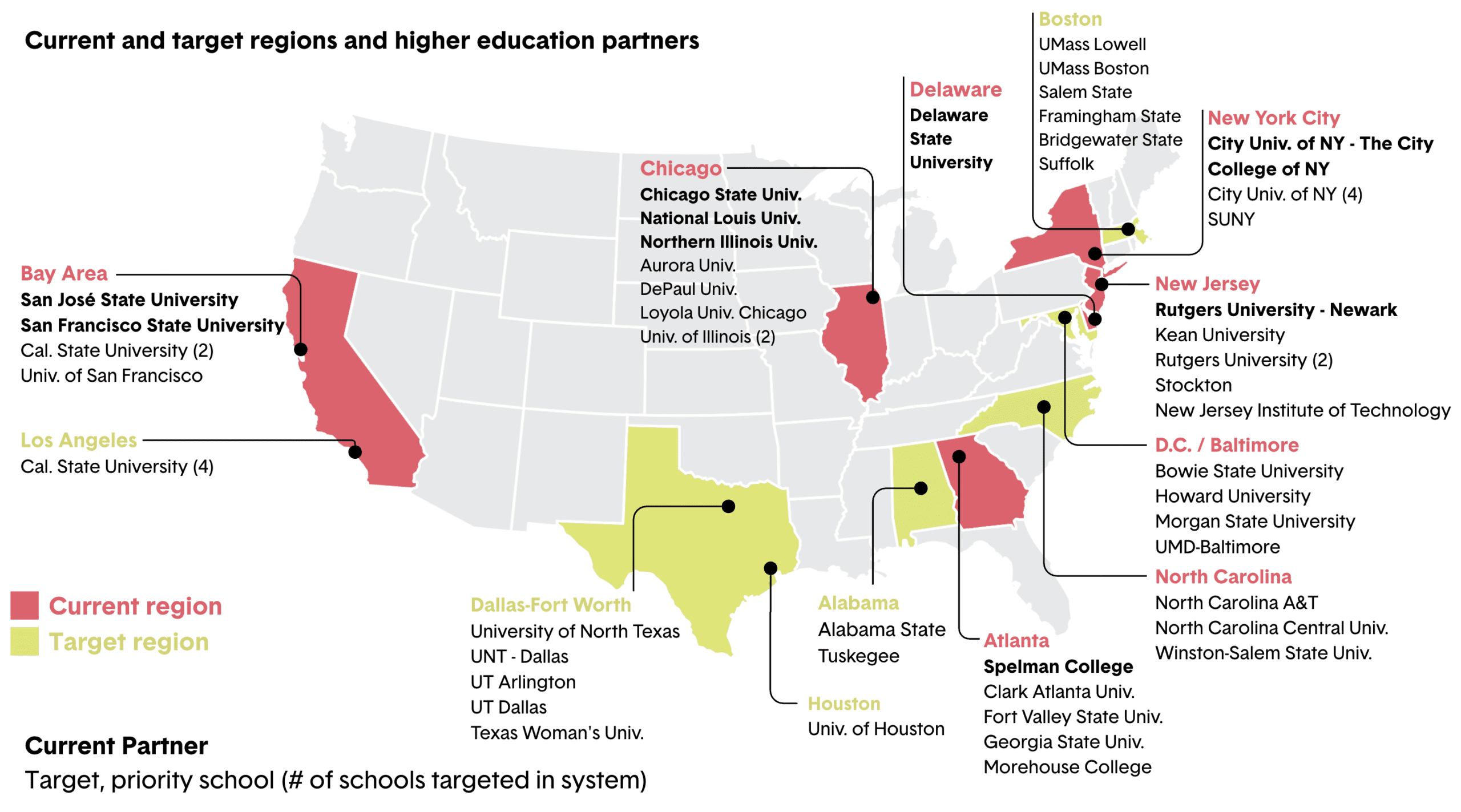
While staying open to opportunity, we will prioritize regions with robust employer and philanthropic ecosystems that can support coaching, hiring and sustainability, and with significant concentrations of our target institutions and students. Within these regions, Braven will partner with higher education institutions that demonstrate strong leadership committed to high-quality, career-connected learning. This regional focus allows us to balance national relevance with local depth, enabling shared infrastructure and stronger employer engagement. We will continue to grow in our six current regions — Atlanta, the Bay Area, Chicago, Delaware, New Jersey and New York City —- and expand to at least three new markets.
Historically, Braven grew school-by-school, which was critical for learning, refining our model and building deeply rooted programs, but constrained how quickly we could scale. Now, with a proven partnership playbook and a dedicated higher education partnerships team, we are streamlining our approach to make expansion faster and more consistent. To accelerate growth, we are increasingly pursuing system-level partnerships with higher education networks and public university state systems to unlock multi-campus adoption.
We are also expanding our work with Historically Black Colleges & Universities (HBCUs), building on strong partnerships with Spelman College and Delaware State University, where shared mission, leadership networks, and aligned student outcomes create growth opportunities similar to public university and state system expansion.
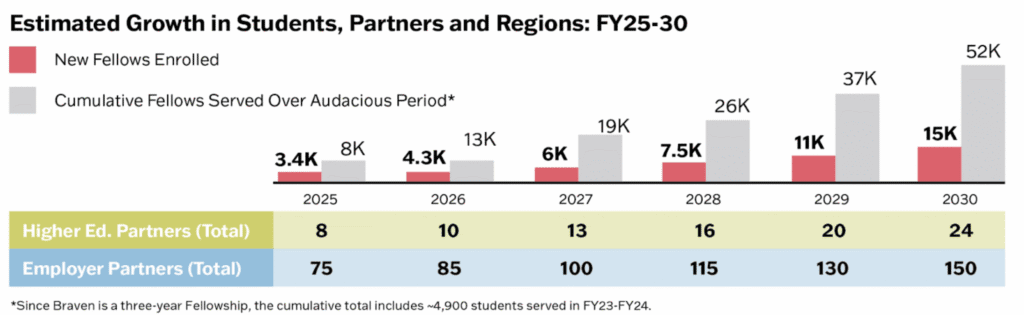
In parallel, we’ll deepen our existing employer partnerships and more than double our network from 75 to 150 employers. We select mission-aligned companies with strong cultures of skilled volunteering and local presence in our regions. Our priority is fast-growing industries with large entry-level hiring needs and clear advancement pathways — such as finance, consulting, and health care — where student demand is high and employers are eager to improve early talent pipelines. We also recruit volunteers from sectors where student interest is high even if employer resources may be limited — like government, education, the arts and nonprofits. A core strategy is positioning the Braven Leadership Coach role as a part of companies’ learning and development pipelines. Several leading employers already embed the role into management tracks in different ways, making it both a talent development opportunity and a high-impact way to connect with emerging professionals.
We are building toward a future where career outcomes are as central to higher education as access and graduation — supported by funding incentives, stronger employer-college collaboration, and practical knowledge. Today, most under-resourced colleges already do more with less to enroll and graduate students. Even when institutions want to launch students into strong first jobs, the financial, human, and technological resources are often insufficient. Braven—in deep collaboration with its partners—will expand its influence as a field leader through three reinforcing strategies to transform this reality:
A. Generate and share actionable insights to strengthen the field
We will use the data and learnings from the rigorous external evaluations and own data collection to strengthen our program and equip others to scale what works. Specifically, we will:
B. Align higher education and employers to better serve students
Braven is already serving as a bridge between sectors: our annual convening draws ~400 leaders from higher education, industry, and government who are committed to improving postsecondary-to-career outcomes. We will expand on this momentum to:
C. Shift public policy and funding to prioritize career outcomes
We will:
Together, these efforts will help make graduating into strong careers a reality for students across the country, starting with the institutions where it matters most.
To power both pillars of our strategy, Braven will invest in infrastructure that makes our model easier to adopt, more efficient to deliver, and more valuable to partners. We’re automating operations like volunteer matching and reporting, program data analysis, and backend operations. By streamlining processes and automating manual tasks, these investments will lower our lifetime cost-per-student, putting us on the path to our $3,000 target (32). At that cost level, our shared investment model becomes sustainable at scale. Institutions can maintain their current $500–$1,000 contribution per student, and employers, local philanthropy and public funding can realistically cover the rest. The result is a high-impact, cost-effective solution that delivers strong outcomes at a fraction of what many high-resource institutions spend.
We’ll also continue to innovate our model to stay relevant and increase value to partners. On the employer side, we’re enhancing the Leadership Coach experience by aligning it more closely with companies’ internal learning and development — increasing its appeal as both a volunteer opportunity and a talent development tool. We’re also creating more opportunities for hiring managers to connect with students and support their recruiting priorities.
For higher education partners, we’re making the experience more flexible — better aligned with varied academic calendars and credit structures. As a natural evolution of our model, we will also explore ways to strengthen the full suite of schools’ career services offerings through programming across the student journey (e.g., first-year orientation) and tools like analytics dashboards to better track student needs. These new services will reach more students and fill critical service gaps, thus unlocking greater value for higher education partners without dramatically expanding costs.
Highly resourced institutions hold the largest endowments of $1 million per student — correlated with much higher spending on student services like career advising (33) — while the typical school Braven serves has a mere $15,000 per student. But for just a $500-$1,000 per student fee — a fraction of what the most well-resourced institutions spend — Braven delivers comparable career outcomes, expanding access to opportunity and upward mobility.
“Braven brings the career skills and networks our students need — and that we can’t easily build ourselves. That’s why demand is growing across campuses. They’re an essential partner in delivering on our collective mission.”
By 2030, Braven will have directly supported 50,000 Fellows across 25 financially constrained colleges and universities that serve many low-income and first-generation college students — unlocking over $8 billion in lifetime earnings (34). These Fellows will launch into strong careers with earnings on par with their higher-income peers — while Braven helps shape the policies, funding, and practices that influence outcomes for hundreds of thousands more.
Progress signs | ||
Over the initial years, we will track the following early signs of change: | ||
| ||
| Project results | ||
Goals | Baseline | Targets in 2030 |
| More college students access quality career preparation | 14K students have participated, with 3.4K new Fellows in the 2024-25 academic year | 50K students will have participated during this period, including 15K new Fellows in the 2029-30 academic year |
| Braven Fellows experience improvements in quality opportunity attainment |
|
|
| Target institutions and employers are deeply embedding high-quality, career-connected learning |
|
|
| Increased public support and investment for “high-quality” career services | 2 states (Illinois and New Jersey) where Braven has secured funding for implementation | 10 state or federal policies incentivize career-connected learning by permanently embedding prioritization into public programs, increasing funding and/or incentivizing transparency around career outcomes |
Braven’s long-term goal is for the low-income and first-generation college students at the nation’s most under-resourced colleges to reliably launch into strong first jobs. As Braven grows to its full potential, we will stay lean and focused — directly supporting the campuses that need it most while advancing the field through data, innovation, and policy influence.
Today, no single entity is accountable for helping low-income and first-generation college students land quality jobs after college. This gap is especially acute at under-resourced institutions where leaders are stretched thin by urgent student needs like food, housing, and mental health. That’s why we believe a direct-service provider with a relentless focus on outcomes will always be essential. Even as we aim to shift the broader field, we expect to directly serve a core group of institutions where our support is most needed and impact is most catalytic. At scale, we anticipate Braven will directly support schools enrolling approximately 10% of our target student population (approximately 100,000 students) (36), expanding access while proving what’s possible in the most resource-constrained settings.
Our financial model is designed to sustain and scale this dual role. Braven already operates on a shared investment model across regions, with institutions, employers, philanthropy, and public partners all contributing to program delivery. As we grow, we project that most of our regions will reach financial self-sufficiency, with higher education and employer partners covering approximately 65% of each region’s costs and the rest coming from local philanthropy and aligned public funding. National philanthropy will be focused where it is most valuable: on innovation, shared infrastructure, influence, and targeted support for high-need regions — capped at 25-30% of our budget.
Over the past 12 years, we have collected strong evidence that our model works. A quasi-experimental study by Stanford researchers, a pre-post study by Harvard researchers, and a survey of Fellows done by the Search Institute show statistically significant growth in Fellows’ four career-building assets that matter most: skills, experience, networks and confidence.
We see how building these assets translates into college and career outcomes in the data we regularly track. Amongst Braven’s 2024 graduates (37):
| College experience |
|
| Career outcomes |
|
We have shown we can scale efficiently. Braven has tripled our reach from 1,100 new Fellows in 2021 to 3,400 new Fellows in 2025. Simultaneously, we’ve demonstrated that we can hit our target costs of $3,000 per student when we operate at full scale (such as at Spelman College, where we serve 600 students). We have also built a national network of 75 employers — including Adobe, Barclays, Capital One, Deloitte, JPMorganChase, LinkedIn, Prudential and Salesforce — with a volunteer network of more than 5,000 professionals who return semester after semester.
THE BUDGET: COST AND REVENUE NARRATIVE
COSTS
Delivering on our vision will require $333M over five years (FY26-FY30), with our annual budget increasing from $48M in 2026 to $82M by 2030. Along with $21M (6%)
invested in our reserves, this investment is structured around the following main activities:
REVENUE
We expect philanthropy to cover 57% ($191M) of the total budget, co-investments from employers and higher education partners to cover 36% ($120M), and public revenue and interest income to cover the remaining 7% ($22M).
For philanthropy, we already have $127M committed. For the remaining $64M, we have a clear path to another $20M through existing donors and plan to fill much of the remaining $44M gap through expanded regional fundraising. Beyond philanthropy, we already have $12M committed from employer partners. With a 90% partner retention rate, $41M is likely to renew, and we have a strong pipeline for future growth.
Braven’s plan represents a strong return on investment on multiple levels — not just for the students we serve, but for their communities and the country, driving $8B in lifetime earnings for low-income and first-generation students and helping to resurrect the American dream.
THE BUDGET DETAILS
In millions, USD
Expenses | Year 1 | Year 2 | Year 3 | Year 4 | Year 5 | Total | |
1) Scale what works | $25.9 | $31.9 | $45.0 | $50.0 | $56.7 | $209.4 | |
Regional program delivery | $7.7 | $9.8 | $12.3 | $14.9 | $17.4 | $62.2 | |
National (centralized) program delivery | $10.7 | $13.0 | $20.7 | $22.8 | $25.9 | $93.2 | |
Data and technology (e.g., software) | $0.7 | $0.8 | $0.9 | $0.9 | $0.9 | $4.3 | |
Other direct implementation expenses | $0.2 | $0.2 | $0.3 | $0.3 | $0.3 | $1.2 | |
Indirect expenses | $6.6 | $8.1 | $10.7 | $11.1 | $12.1 | $48.6 | |
2) Shape the field | $4.6 | $5.6 | $7.5 | $7.7 | $7.9 | $33.3 | |
Policy (staff and contractors) | $0.6 | $0.6 | $0.9 | $1.0 | $1.0 | $4.0 | |
Marketing & communications (staff and reports) | $0.9 | $1.1 | $1.7 | $1.7 | $1.7 | $7.1 | |
Field engagement (staff) | $1.0 | $1.1 | $1.2 | $1.3 | $1.5 | $6.2 | |
Research (staff and third-party evaluations) | $0.4 | $0.8 | $1.3 | $1.3 | $1.2 | $5.0 | |
Events and convenings | $0.5 | $0.6 | $0.6 | $0.7 | $0.7 | $3.2 | |
Indirect expenses | $1.2 | $1.4 | $1.8 | $1.7 | $1.7 | $7.8 | |
3) Strengthen for scale | $17.5 | $19.5 | $17.5 | $18.3 | $17.4 | $90.2 | |
Data and technology teams | $10.6 | $10.5 | $6.9 | $6.3 | $4.3 | $38.6 | |
Innovations to our model | $0.2 | $1.2 | $2.6 | $3.9 | $5.1 | $13.1 | |
Operating reserves | $2.8 | $3.6 | $4.8 | $4.8 | $5.2 | $21.2 | |
Indirect expenses | $3.9 | $4.2 | $3.2 | $3.2 | $2.8 | $17.3 | |
Total Expenses | $48.0 | $57.0 | $70.0 | $76.0 | $82.0 | $333.0 | |
Projected Revenue | Year 1 | Year 2 | Year 3 | Year 4 | Year 5 | Total | |
Committed Philanthropy (including Audacious) | $34.8 | $32.0 | $25.0 | $20.3 | $15.0 | $127.1 | |
Committed Employer Partners & Higher Ed Revenue | $9.2 | $5.0 | $2.9 | $1.2 | $0.7 | $18.9 | |
Prospective Higher Ed Revenue | $0.0 | $1.7 | $2.6 | $5.0 | $7.9 | $17.2 | |
Prospective Public Revenue & Interest Income | $1.5 | $2.5 | $4.0 | $5.8 | $8.0 | $21.8 | |
Prospective Philanthropic Revenue | $1.0 | $4.0 | $18.3 | $20.4 | $20.6 | $64.3 | |
Prospective Employer Partners | $1.5 | $11.8 | $17.2 | $23.3 | $29.8 | $83.6 | |
Total Revenue | $48.0 | $57.0 | $70.0 | $76.0 | $82.0 | $333.0 | |
*Revenue as of February 23, 2026
