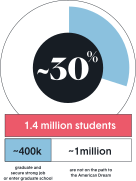
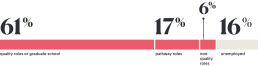



Nationally, ONLY 30% OF 1.4 MILLION STUDENTS WITH LIMITED FINANCIAL RESOURCES OR WHO ARE THE FIRST IN THEIR FAMILY TO ENROLL IN COLLEGE each year will graduate and secure a strong first job or enter graduate school.

A full-time role that requires a bachelor’s degree and includes some combination of promotion pathways, employee benefits, and a market-competitive starting salary, or enrollment in graduate school.

A role that does not require a bachelor’s degree but helps a student’s financial sustainability, is aligned with their career interests, and will likely lead to more career-accelerating possibilities through skill development

A role that does not require a bachelor’s degree, offers limited runway to additional career-accelerating opportunities, and is not aligned with a student’s career interests
For college students, internships serve as critical proof points of experience that open professional doors.
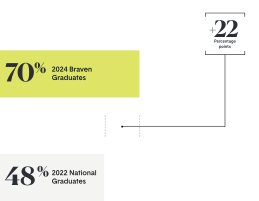
Compared with graduates nationally, Braven 2024 graduates were 22 percentage points more likely to have at least one internship or similar career-accelerating experience during college.
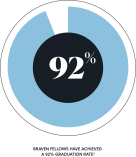
Nationally, only about 7 in 10 students graduate within six years of college enrollment.1 Braven Fellows, who typically join us during their sophomore or junior year, are persisting and graduating at encouraging rates.
Braven Fellows have achieved a 92% six-year on-time graduation rate.2
1.National comparison is the implied six-year graduation rate for Pell Grant recipients who were full-time, first-time degree/certificate-seeking undergraduate students in the 2017 starting cohort (adjusted) at four-year public Title IV institutions, after accounting for those who persisted from freshman to sophomore year and from sophomore to junior year. Sources for data: U.S. Department of Education, National Center for Education Statistics, IPEDS, Winter 2023–24, Graduation Rates component (provisional data); Pitcher, McCall, and Parson, Kelle. “More to the Retention Story: Exploring Second- to Third-Year Retention at 4-Year Colleges and Universities.” American Institutes for Research. July 2023.
2. Six-year graduation rate of Braven Fellows includes students who enrolled as first-time freshmen at SJSU and RU-N, not including those who took Braven as seniors, transfers, or international students. SJSU and RU-N are the only core sites included in the six-year graduation rate calculation because they have reached a critical number of graduates to date.
To date, Braven has partnered with external research teams at Harvard Graduate School of Education, Stanford Graduate School of Education, and Search Institute to evaluate its programs’ impact on Fellow outcomes.
The research team at Harvard Graduate School of Education, led by Monica Higgins, explored the impact of Braven’s model on Fellow’s non-cognitive skills and network strength. Fellows made statistically significant growth in five non-cognitive domains central to Braven’s program design:
The Harvard team also conducted social network analysis to determine the degree to which Fellows had connections with their Braven cohort members in terms of friendships and individuals from whom they sought advice. They found that Braven Fellows saw statistically significant growth in both types of networks over the course of the semester.
The research team at Stanford GSE did a quasi experimental study and qualitative study of the Accelerator Course’s impact at San Jose State University on college persistence. Similar to the Harvard team’s findings, they found that Braven Fellows saw statistically significant growth in five key non-cognitive areas: grit, sense of social and academic fit, academic self efficacy, job search self efficacy, and career self efficacy. The qualitative study found the biggest impact on development of confidence and a sense of empowerment to achieve career goals. Alongside the Harvard findings, these research results indicate that Braven’s model is directly addressing the gaps that keep many college students with fewer resources from securing strong jobs when entering the job market.
Social capital is positively associated with outcomes such as greater educational attainment, full-time employment, and career advancement. In 2020-2021, Braven partnered with Search Institute (a research and practice organization), the Bill & Melinda Gates Foundation, and five other nonprofits to develop reliable measures of social capital. Results show that Braven Fellows emerge with high levels of Braven-supported and self-initiated social capital, dynamic networks, and confidence about past and future progress. Specifically, 87% of Fellows say that after Braven they have people with varied careers and career interests in their networks, 91% of Fellows say they have developed or strengthened skills they need to pursue their goals as a result of taking Braven, and 56% of Braven Fellows score in the 75th percentile or higher in gaining social capital from their relationships with their leadership coaches.
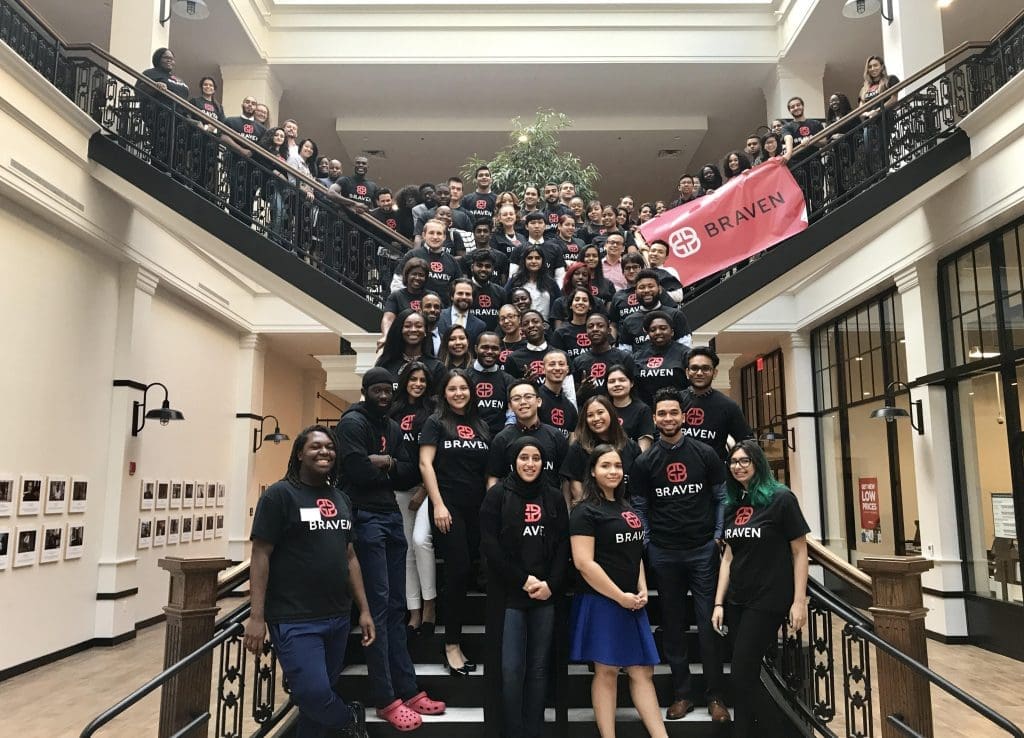
Braven began in 2013 as a pilot with 17 students at San José State University. In the decade since, we have grown to serve 7,400+ Fellows at seven schools across five regions nationwide. Our annual impact and jobs reports highlight Braven’s influence through the stories of our inspiring Fellows.